+86-15371769898
 [email protected]
+86-15371769898[email protected]Every roller has a moment when its surface stops doing what the drawing promised. The print starts streaking, the film picks up a scratch, the web begins to slip, and a line that ran clean for months suddenly needs attention. In most of those cases the core is still perfectly sound. It is the working surface that has given up.
Carbide cladding exists for exactly that situation. It is not a decorative finish or a sales adjective, but a metallurgical layer of hard carbide particles held in a tougher alloy matrix and fused onto the roll body so that the surface outlasts the base metal by a wide margin. What follows is a practical look at how the process works, where it earns its cost, and what should appear on a drawing when you order one.
Cladding is often confused with plating. In plating, a thin film grows atom by atom on the surface. In cladding, carbide particles, most often tungsten carbide but sometimes chromium or vanadium carbide, are carried in a nickel-based, cobalt-based or iron-based matrix, and that mixture is melted onto the substrate so the two form a metallurgical bond rather than a mechanical one. The finished layer is usually somewhere between 0.3 mm and 6 mm thick. The carbide delivers the wear resistance; the matrix holds the particles in place and contributes toughness, corrosion resistance and a certain amount of give under load.
The distinction matters when someone quotes a "carbide coating" at a fraction of the expected price. It is usually a thin sprayed or electroplated layer. Both technologies are legitimate; they simply solve different problems, and a roller that sees grit, filler or doctor-blade pressure all day is rarely the right home for a two-hundredth-of-a-millimetre film.
Rollers seldom fail from one clean mechanism. Four show up again and again on production lines: three-body abrasion, where grit, pigment or filler is dragged between roller and web; erosion from fast-moving particles or slurry; adhesive wear and galling from metal-to-metal contact or poor lubrication; and corrosion-assisted wear where acids, salts or aggressive cleaning agents soften the surface so that abrasion removes it faster.
Carbide helps first because it is hard. Tungsten carbide sits in the region of 1,500 to 2,000 HV, against roughly 700 to 1,000 HV for hard chrome and a few hundred HV for a normalized steel core. Hardness is not the whole story, though. A matrix that is too soft lets particles pull out of the pool; a matrix that is too hard can crack when something heavy lands on the roll.
Indicative only: relative abrasion resistance of common roller surface treatments in sliding three-body abrasion. Real rankings shift with carbide grade, volume fraction, matrix hardness and the counterface material.
Two variables do most of the tuning. Carbide fraction raises abrasion resistance but lowers toughness once it passes a certain point, and thickness buys service life at the cost of weight, grind time and money. There is a sweet spot for every application, and it is rarely the maximum value on either scale.
Four routes dominate industrial roller work. They differ mainly in how heat reaches the substrate, which in turn drives dilution, distortion and how much of the carbide actually survives the trip.
| Process | Typical thickness | Dilution and heat | Carbide content | Best fit | Watch-outs |
|---|---|---|---|---|---|
| Laser cladding | 0.3 to 3 mm | Very low dilution, narrow heat-affected zone | Up to about 60 percent | Precision rolls, mirror work, thin walls | Slower deposition, higher capital cost |
| Plasma transferred arc | 1 to 6 mm | Moderate dilution, controlled preheat | 30 to 60 percent | Large rolls, rebuild and repair | Preheat and cool-down discipline needed |
| HVOF cermet spray | 0.05 to 0.5 mm | Low substrate heating | 80 to 90 percent in a cobalt binder | Fine finish, erosion-corrosion duty | Thin layer, line-of-sight, not for heavy impact |
| Torch or open-arc overlay | 1 to 8 mm | Higher dilution, wider heat-affected zone | 20 to 50 percent | Heavy abrasion, field repair, thick build-up | More finishing stock, more distortion risk |
Dilution is the quiet variable. In laser and plasma transferred arc work it can be held to a few percent, so the carbide particles keep their shape and hardness. In torch and open-arc overlays more of the substrate melts into the pool, producing a tougher but less carbide-rich layer. HVOF never melts the substrate at all, which is why it holds the highest carbide content and the thinnest layer at the same time.
The same specification can be perfect on one line and wrong on the next. A few patterns repeat across the industries we build for.
Mineral fillers, glass fibre and pigment masterbatch grind a roller from the surface down. Carbide-rich layers of moderate thickness with a fine final finish typically outlast chrome several times over.
Doctor blades, inks and solvents attack both by abrasion and by chemistry. A thin, uniform, well-polished layer with good corrosion resistance protects register accuracy as well as the surface.
High nip loads, wet conditions and continuous blade contact punish the shell. Cladding selection here usually balances wear life against the risk of marking the sheet, which is why finish control is as important as hardness. More detail sits in our papermaking application notes.
Scale, hot strip and coil handling bring impact and thermal cycling into play. Tougher matrices with moderate carbide content usually beat maximum-hardness layers in these positions.
The useful question is not "which coating is best" but "which wear mechanism is dominating this position". Once that is answered, thickness and carbide fraction follow almost automatically.
Most of the problems we see in clad rollers are decided before the first arc strikes, at the specification stage. This is the sequence we walk through with customers.
Straightness, journal condition, wall thickness and existing coating all constrain what can be applied. A tired core with a new cladding is still a tired core.
Tungsten carbide in a nickel-based matrix is the general-purpose workhorse. Cobalt binders suit impact and corrosion; iron-based systems can be attractive on large, cost-sensitive bodies.
Allowance matters as much as the nominal figure. Finishing typically removes 0.2 to 0.5 mm depending on diameter and required finish; the layer left after grinding is what actually protects the roll. Our note on whether coating thickness on tungsten carbide rollers can be customized covers this trade-off in more detail.
The substrate is usually turned or ground undersize first, then preheated in a controlled way so the thermal cycle does not introduce a bow that shows up at final grinding.
Grinding, polishing and, where required, superfinishing follow. Every stage is inspected before the roll moves on, which is the only reliable way to catch a bond defect before it becomes a line stoppage.
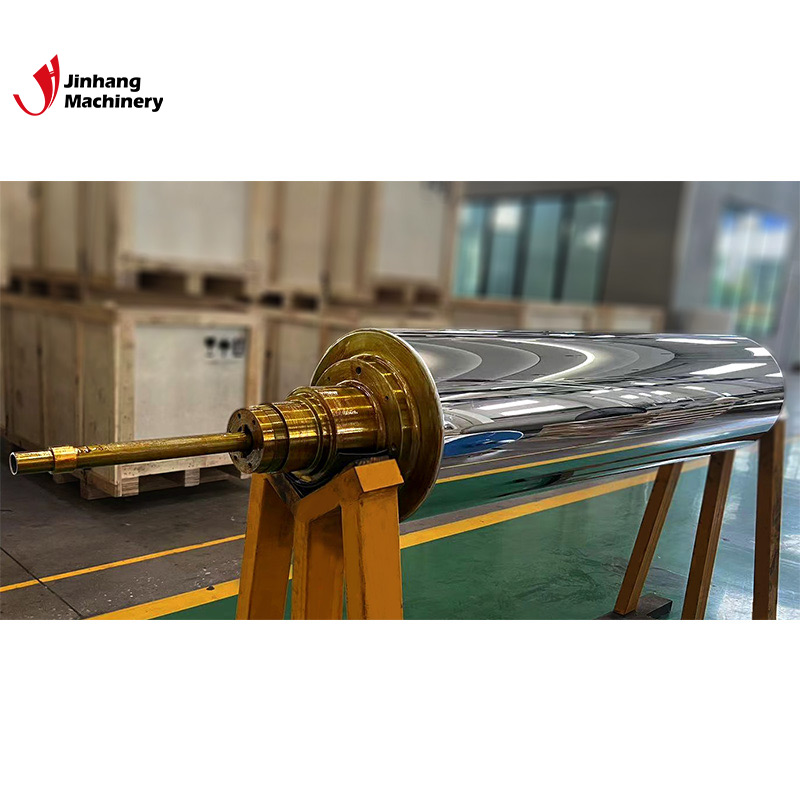 Acid-Resistant Tungsten Carbide Mirror RollerCustom mirror-finished tungsten carbide roller for corrosive, high-pressure environments, offering wear resistance and consistent surface quality for demanding rolling applications.View Product →
A clad surface is only as good as the geometry it sits on. Two lists cover most of the conversation we have with drawing reviewers.
Where shock loading is part of daily life, a tougher specification with a moderate carbide fraction usually outperforms a maximum-hardness layer that chips at the edges. Test rolls built for exactly that kind of evaluation exist for a reason, and they are worth requesting before committing a full set to a new specification.
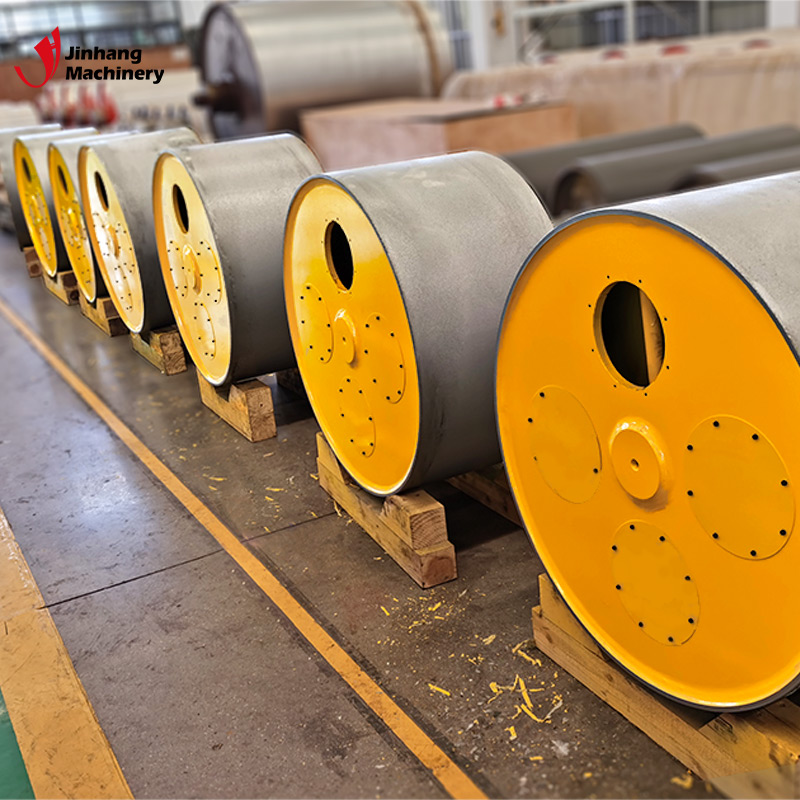 Impact-Resistant Tungsten Carbide Coated Test RollerCustom test roller with impact-resistant carbide coating, suited to evaluating toughness and reducing downtime before committing a full set to high-shock specifications.View Product →
Carbide cladding costs more per roll than hard chrome, and it would be dishonest to pretend otherwise. The comparison that matters is cost per operating hour: a layer that lasts three to five times longer, with fewer unplanned changeovers, usually wins comfortably, especially where a stoppage costs more than the roll itself.
That capacity matters practically: turning, grinding, milling, boring, welding, dynamic balancing, polyurethane casting and automated blasting under one roof means a clad roll does not spend weeks travelling between subcontractors, and a specification can be adjusted while the job is still on the floor.
Not always. "Coating" is used loosely for thin sprayed or plated films, while cladding implies a fused layer of meaningful thickness. Ask for the process, the layer thickness after grinding, and the carbide fraction, not just the material name.
Enough to survive the finishing allowance and the wear life you expect. Most roller work lands between 0.3 mm and 3 mm after grinding, with heavier overlays on large-diameter bodies in coarse abrasive service.
Yes, within limits. Regrinding removes a small amount of material and restores finish; re-cladding requires stripping the old layer and rechecking the core. Both are far cheaper than a new body.
Thick, high-carbide layers in brittle matrices can develop fine mud-crack patterns, which are usually tolerable. Genuine problems come from poor preheat, excessive dilution or impact loads, and they are avoidable with the right process choice.
Any thermal process moves metal. Low-dilution laser and plasma transferred arc work keep the heat-affected zone narrow, and controlled preheat plus symmetrical deposition keeps runout inside drawing tolerance.
A drawing with base material, dimensions and tolerances, plus the operating conditions: line speed, nip load, temperature, the medium being handled, and what failed on the previous roll. That last point is often the most useful piece of information in the whole package.
Carbide cladding is not a universal upgrade, and treating it as one is how money gets wasted. It is a targeted answer to abrasion, erosion and corrosion-driven wear on a roll body that is otherwise sound. Get the mechanism right, specify the layer honestly, control the finishing, and the surface will quietly outlast several of its predecessors without anyone on the line noticing until the maintenance log does.
Dedicated to developing and manufacturing various shapes of rolls with different roll structures.
Phone: +86-15371769898
Email: [email protected]
Add: 9 Lifa Avenue, Chengdong Town, Haian County, Nantong City, Jiangsu Province, China
Copyright© 2025 Jiangsu Jinhang Machinery Manufacturing Co., Ltd. All Rights Reserved.
 Custom Thin Walled Roller Manufacturers


 English
 русский
 Deutsch