+86-15371769898
 [email protected]
+86-15371769898[email protected]Hypalon is not one specific rubber anymore. It is the former DuPont trademark for chlorosulfonated polyethylene (CSPE), a synthetic rubber family that still appears on industrial roller specifications long after the original branded product was discontinued. The practical conclusion for buyers: specify the compound and its measured properties, not the brand name. In roller service, a clear material specification — hardness, temperature range, chemical resistance — decides whether a cover performs for years or fails prematurely within the first months of service.
That conclusion is not theoretical. A roller cover that looks identical to the old Hypalon-type cover can differ in polymer content, curing system, and filler loading. Two covers carrying the same generic name can behave very differently toward acids, solvents, ozone, and cold. For maintenance planners and design engineers, understanding what Hypalon actually was — and what replaced it — is the first step toward buying a roller cover that survives the process.
Hypalon was a DuPont brand name for chlorosulfonated polyethylene, a synthetic rubber made by treating polyethylene with chlorine and sulfur dioxide. The process creates a saturated polymer backbone with chlorine and sulfonyl chloride groups along the chain. The saturated backbone resists ozone, ultraviolet light, and weathering; the chlorine content provides flame resistance and broad chemical resistance; the sulfonyl chloride groups enable crosslinking, so the final compound behaves like a vulcanized rubber with genuine elasticity and recovery.
DuPont discontinued the Hypalon trademark around 2009-2010, but CSPE did not disappear. Other manufacturers continue to produce chlorosulfonated polyethylene under their own names, and the generic term CSPE now identifies the material category more accurately than the old brand. Engineers still say "hypalon" when they mean a CSPE-type rubber. That shorthand is practical, but if you buy a custom roller, compound quality and property data vary by supplier, so the brand name carries less meaning than the tested values behind it.
CSPE earned its place on roller specifications through balanced performance in aggressive environments. The table below lists the properties that decide whether a roller cover survives repeated contact with process fluids, weather, ozone, and wash-down chemicals.
| Property | Typical CSPE Performance | Why It Matters on Rollers |
|---|---|---|
| Chemical resistance | Resists dilute acids, alkalis, and oxidizing chemicals; moderate oil resistance | Survives wash-down chemicals and process fluid splash without swelling or softening |
| Ozone and UV resistance | Excellent, thanks to the saturated polymer backbone | Stable near corona treaters, motors, and outdoor exposure |
| Low-temperature flexibility | Serviceable to approximately minus 30 degrees Celsius | Prevents stiffening and surface cracking in cold plants and after shutdowns |
| Heat resistance | Continuous use to roughly 120 degrees Celsius | Works in warm process areas; above this, EPDM or silicone is a better fit |
| Flame resistance | Self-extinguishing because of chlorine content | Reduces fire risk in printing, coating, and electrical environments |
| Abrasion resistance | Good, though not equal to polyurethane | Handles normal web and sheet contact; not intended for heavy nip wear |
The temperature window deserves special attention in roller specifications. A cover rated for 120 degrees Celsius continuous service can handle short peaks above that, but every rise in surface temperature accelerates aging and shortens cover life. At the cold end, CSPE keeps its flexibility far better than many general-purpose rubbers, which is why low-temperature-resistant CSPE rollers are a standard choice for equipment installed in unheated buildings or cold climates.
No single elastomer covers every service condition. The fast way to test a material choice is to compare the main rubber families on the demands that actually appear on a production line: oil, ozone, acid, heat, abrasion, and flame.
| Property | CSPE (Hypalon type) | EPDM | Nitrile (NBR) | Neoprene (CR) |
|---|---|---|---|---|
| Ozone and weather resistance | Excellent | Excellent | Good | Good |
| Oil and fuel resistance | Fair to good | Poor | Excellent | Good |
| Dilute acid resistance | Excellent | Good | Fair | Good |
| Heat resistance | Good, about 120 degrees C | Excellent | Good, varies by compound | Good |
| Flame resistance | Self-extinguishing | Poor | Fair | Moderate |
| Abrasion resistance | Good | Good | Good | Good |
| Low-temperature flexibility | Good | Good | Fair to good | Fair |
Read the table by threat, not by habit. If oil and petroleum solvents dominate the process, nitrile is usually the first choice. If persistent heat and ozone are the problem, EPDM outperforms CSPE. Neoprene sits in the middle as a general-purpose option. CSPE earns its place when the environment combines acid, weather, and flame risk — for example, a wash-down area where cleaning chemicals alternate with outdoor air, or a coating line where solvent vapors meet ozone from electrical equipment.
That combined profile is exactly what keeps CSPE on roller drawings, even though the old brand name is gone.
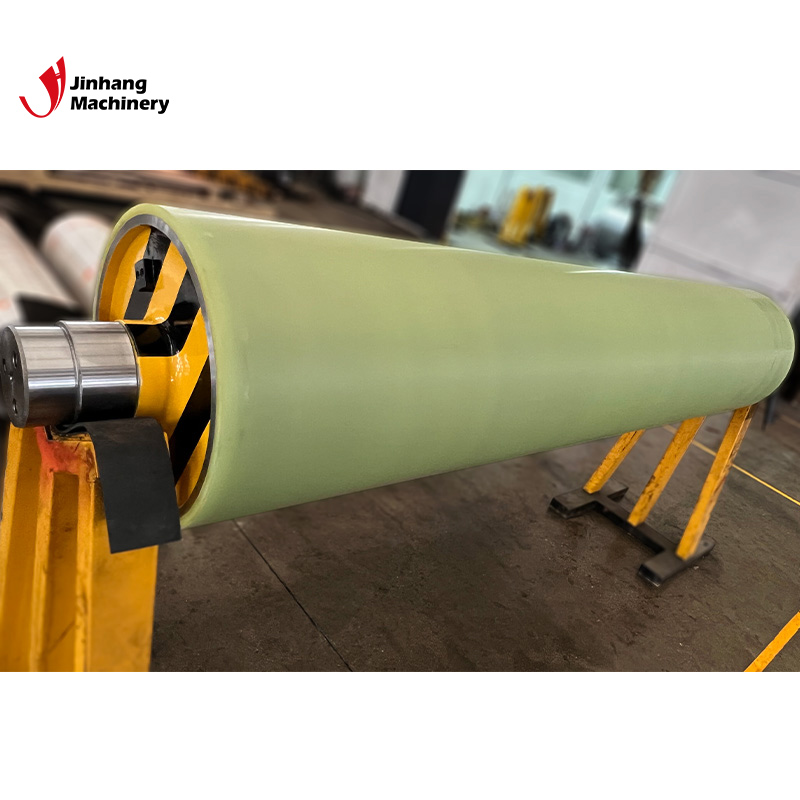 Ozone-Resistant EPDM Rubber Rollers for Industrial UseThese rollers use EPDM rubber to withstand ozone exposure, maintaining flexibility and strength in demanding environments. They suit printing, packaging, and conveyor applications where reliable feeding and durability are required.View Product → Water-Resistant Nitrile Rubber Rollers for Wet ConditionsBuilt with nitrile rubber, these rollers resist water, oils, and chemicals, making them ideal for food processing, pharmaceutical, and marine settings. They maintain grip and smooth rotation, reducing downtime in harsh operations.View Product →
On a roller, the elastomer cover protects the steel or aluminum core from process fluids, delivers the friction or release characteristics the web requires, and holds a precise surface geometry over time. A CSPE cover is selected when the line exposes rollers to chemicals, humidity, ozone, or low temperatures that rule out cheaper general-purpose rubbers.
Typical positions include idler and drive rollers on chemical coating lines, web transport rollers running through solvent vapors, wash-down conveyor rollers in food and beverage plants, and processing lines in the rubber and plastics industry where oil mist, ozone, and heat can coexist. In low-temperature service, the cover stays flexible enough to avoid flat spots after shutdown and to resist surface cracking during restart.
Manufacturing a CSPE roller cover is a controlled process, not a commodity fill. The compound is mixed with the correct curatives and fillers, bonded to a prepared core, vulcanized, and ground to the specified diameter and surface finish. A roller manufacturer that controls the bond and the final grind gives you a cover whose physical properties match the compound data, rather than a rubber skin slipped loosely over a metal cylinder.
Low-Temperature Hypalon Rubber Rollers with Wear ResistanceThese Hypalon rollers offer excellent wear and heat resistance while staying flexible in cold conditions. They suit printing, coating, laminating, and refrigerated or outdoor environments, ensuring consistent performance and longer service life.View Product →Ordering a "hypalon" roller today is not the same as ordering one thirty years ago. Because the original branded polymer is no longer produced, the supplier's compound and test data become the real specification. At minimum, the inquiry should cover:
Drawing-based inquiries remove most of the guesswork. When you supply the roller drawing, the manufacturer can match compound, cover thickness, and grind to the actual application, then confirm the expected properties in the quotation. Ordering on a material name alone does not do that. For a broader look at how rubber roller types compare, our detailed guide to rubber roller types and uses covers the wider material family.
Hypalon the trademark belongs to history. CSPE the material is still working, often in places where other rubbers cannot survive. Draw the right lesson from the name change: stop relying on labels and start defining the numbers. Combine a properly specified CSPE compound with a roller builder that controls the bond and the finish grind, and the result is a cover that lasts — not just a replacement part that happens to fit.
Dedicated to developing and manufacturing various shapes of rolls with different roll structures.
Phone: +86-15371769898
Email: [email protected]
Add: 9 Lifa Avenue, Chengdong Town, Haian County, Nantong City, Jiangsu Province, China
Copyright© 2025 Jiangsu Jinhang Machinery Manufacturing Co., Ltd. All Rights Reserved.
 Custom Thin Walled Roller Manufacturers


 English
 русский
 Deutsch