+86-15371769898
 [email protected]
+86-15371769898[email protected]In the specialized field of nonwoven fabric production—including Spunbond, Meltblown, and Needle-punching processes—the heating roller (often referred to as a calender roll) serves as the primary engine for material transformation. While “Temperature” is the catalyst that softens synthetic polymers like polypropylene or polyester, “Pressure” is the mechanical architect that determines the final structure of the fabric. Inconsistent pressure across the roller surface is the leading cause of “cloudy” fabric, variable tensile strength, and massive material waste.
To understand the importance of pressure, one must first understand the engineering challenge of roller deflection. When a heating roller is subjected to the immense nip pressures required for thermal bonding (often reaching several hundred Newtons per millimeter), the steel body of the roller behaves like a beam. Even a solid steel roller will microscopically bend or “bow” under this load.
This creates a phenomenon known as the “Smile Effect,” where the pressure is significantly higher at the ends of the roller (near the bearings and hydraulic rams) and lower in the center.
If the pressure is not perfectly uniform, the center of the nonwoven web will be under-bonded, leading to a “soft” or “fluffy” center that lacks structural integrity. Conversely, the edges may be over-pressed, resulting in “film-like” or “glazed” textures that make the fabric brittle and prone to tearing during winding or conversion.
A common misconception in the factory is that temperature and pressure are independent variables. In reality, they are deeply synergistic. In nonwoven production, heat is transferred via conduction from the roller surface to the fiber web. The efficiency of this heat transfer is directly proportional to the “Contact Pressure.”
Higher pressure forces the fibers closer to the hot steel surface, reducing the microscopic air gaps that act as insulators. If the pressure is uneven, the “effective” temperature the fibers experience will also be uneven, even if the roller surface itself is at a perfect, uniform temperature. This results in localized variations in the fiber’s Glass Transition Temperature ($T_g$) and melting behavior, leading to a final product with inconsistent GSM (grams per square meter) and variable permeability.
To counteract the natural physics of steel deflection, high-precision heating rollers utilize advanced structural engineering. The goal is to ensure that when the production line is at full speed and full pressure, the “Nip Trace” (the contact line between the heating roller and the backup roller) remains a perfectly straight, uniform line.
The most traditional method of ensuring uniformity is Crown Grinding. Engineers grind the roller so that it is slightly “pregnant” or thicker in the middle. Under operational load, the roller center deflects into a straight line. However, a fixed crown only works for a specific pressure setting.
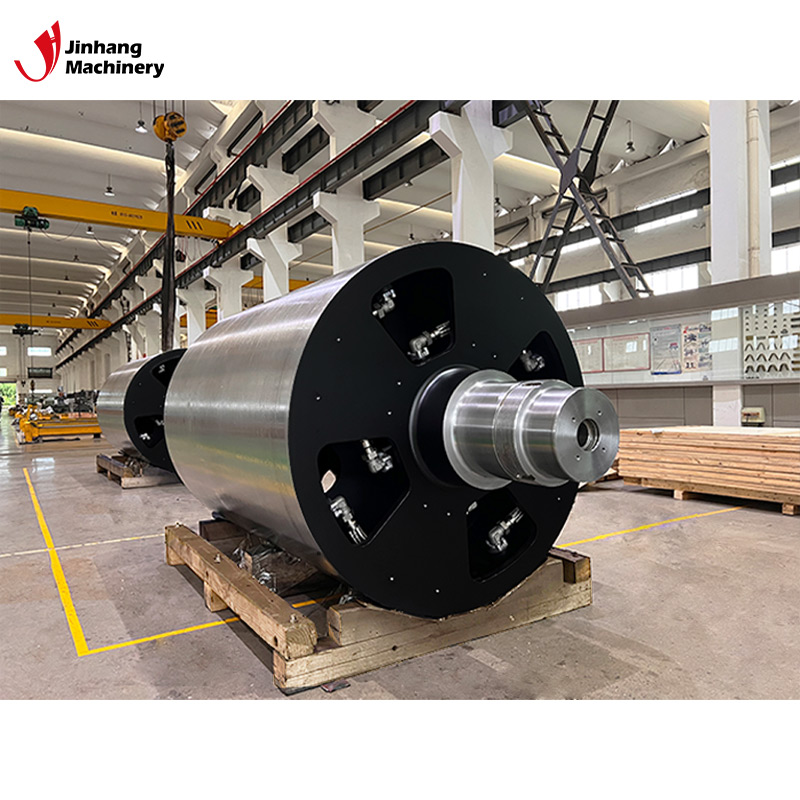
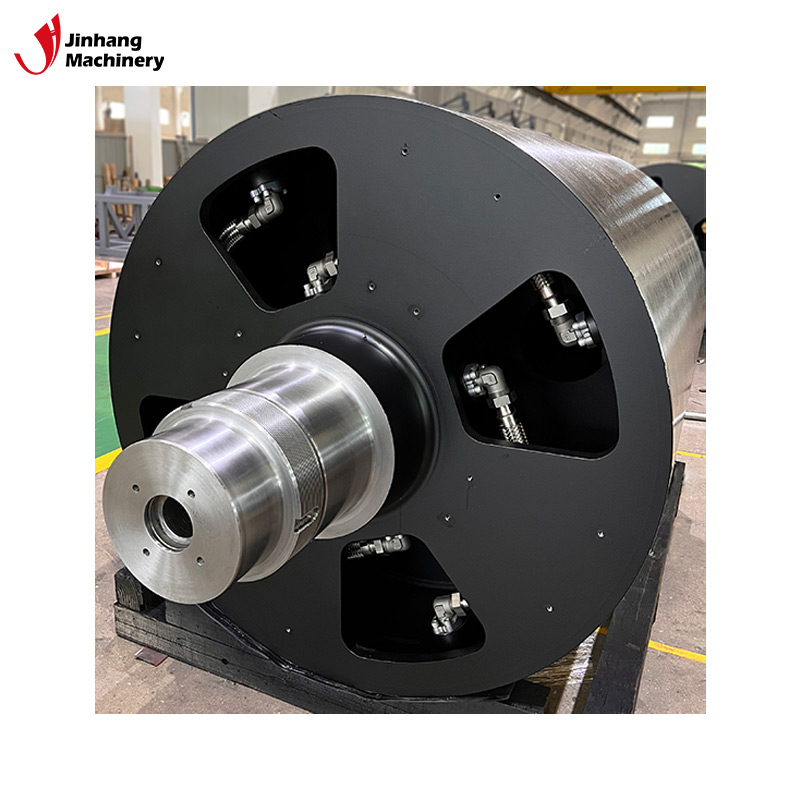
For modern, flexible production lines that switch between light medical fabrics and heavy industrial filters, Variable Crown (VC) Rollers—also known as “Swimming Rolls”—are the gold standard. These rollers feature an internal stationary shaft surrounded by a rotating shell, with hydraulic oil chambers between them. By adjusting the oil pressure inside the roller, the operator can “shape” the roller in real-time to match the specific pressure requirements of the fabric being produced.
While mechanical crown control manages the pressure, the internal flow of the heating medium (usually thermal oil or electromagnetic induction) must be engineered to prevent Thermal Crown. If the ends of a roller are hotter than the center, the steel will expand unevenly, creating a secondary pressure profile that can ruin the fabric. High-performance heating rollers use multi-zone “Drilled Hole” designs or spiral internal baffles. These structures ensure high-velocity fluid flow, which minimizes the “Boundary Layer” effect and maintains a temperature uniformity of $\pm 1\text{°C}$ across the entire roll width, ensuring that thermal expansion does not interfere with the mechanical pressure settings.
| Quality Metric | Uniform Pressure & Temp | Non-Uniform Pressure (Deflected) |
|---|---|---|
| Tensile Strength | Consistent across the web width | Weak center; prone to center-splitting |
| Fabric Thickness | High Precision (e.g., $\pm 0.01\text{mm}$) | Uneven (Crowned or Wedged profile) |
| Surface Finish | Smooth and even matte/gloss | “Cloudy” patches or glazed edges |
| Dye Absorption | Uniform color take-up | Streaking or shading in center/edges |
| Filtration Rating | Consistent pore size | Variable permeability; low efficiency |
| Winding Quality | Flat, stable rolls | “Hard” or “Soft” spots on the finished roll |
Maintaining pressure uniformity isn’t just about the internal hydraulic system; it is also about the microscopic “interface” where the roller meets the nonwoven web. Any degradation of the roller surface can lead to localized pressure spikes or dips.
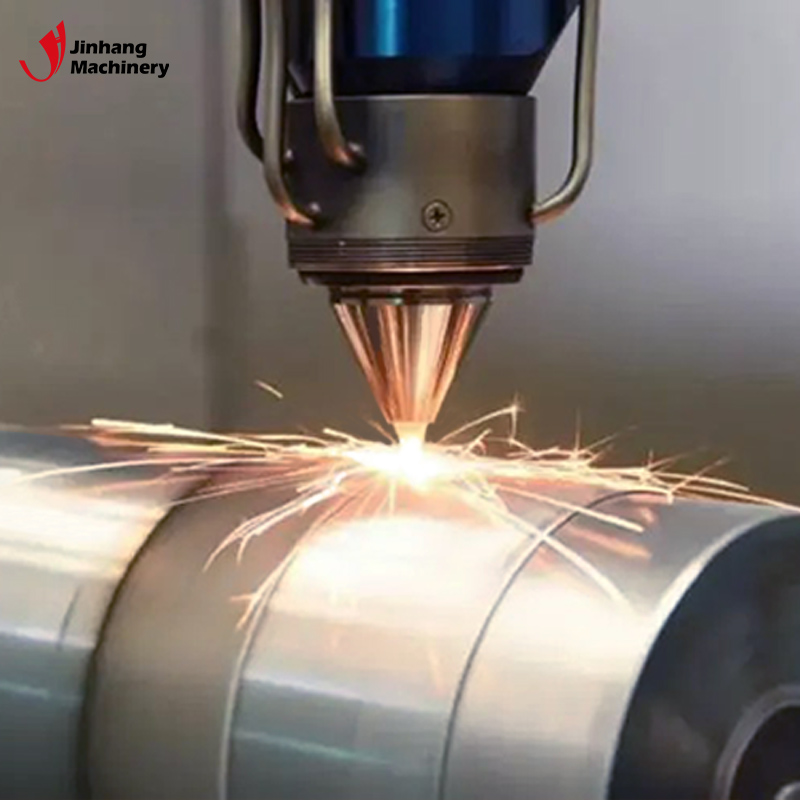
Nonwoven production involves high temperatures and high speeds, which can cause significant wear. Most high-end heating rollers are coated with Tungsten Carbide or Hard Chrome to achieve a surface hardness of $60\text{–}70$ HRC (Rockwell).
A hard surface prevents “pitting” or “grooving” caused by recycled fiber contaminants or carbonized polymer residues. If the surface becomes scarred, the “Effective Nip Pressure” at that point drops, leading to a localized bonding failure. To maintain precision, rollers must be “Super-finished” to a mirror-like roughness ($R_a < 0.1\text{ }\mu\text{m}$), ensuring that every square millimeter of the nonwoven web receives the exact same mechanical treatment.
The most sophisticated heating roller in the world will fail if the mechanical assembly is misaligned. In a “Two-Roll Calender” stack, the axes of the heating roller and the backup roller must be perfectly parallel in both the horizontal and vertical planes.
Misalignment by even $0.05\text{mm}$ will create a “skewed” pressure profile, where one side of the fabric is thinner and more “burnt” than the other. This often results in a defect known as “Camber,” where the fabric curves like a banana when unrolled. Regular preventative maintenance, including thermal imaging to check for hot bearings and laser alignment of the roller housings, is the final step in ensuring that the pressure uniformity remains stable over years of 24/7 operation.
How does “Thermal Expansion” affect my pressure settings?
As the heating roller increases in temperature, the steel expands in all directions. If your heating medium (oil) is not circulated correctly, the roller might develop a “Thermal Crown” where the center expands more than the ends. This changes the physical shape of the roller, which in turn increases the pressure in the center, potentially over-bonding the fabric even if your hydraulic settings haven’t changed.
What is the best way to verify if my pressure is truly uniform?
The most accurate “static” method is using pressure-sensitive film (such as Fujifilm Prescale). You place the film between the rollers and apply pressure; the density of the red color indicates the exact pressure distribution. For “dynamic” real-time monitoring, many modern calenders are equipped with electronic nip sensors or ultrasonic thickness gauges on the exit end of the line.
Why does my fabric have “hard edges” but a soft center?
This is a classic symptom of Roller Deflection. The ends of the roller are supported and pushed by hydraulic rams, but the center is “free” to bend away from the load. To fix this, you either need to increase your “Crown” (if using a fixed-crown roll) or increase the internal hydraulic pressure of your Swimming Roll.
Does a higher production speed require more pressure?
Yes, generally. At higher speeds, the “Dwell Time” (the amount of time the fabric spends in the nip) is reduced. To achieve the same level of fiber fusion in a shorter time, you must often compensate by increasing both the temperature and the pressure to force the heat into the fiber core more rapidly.
Is it possible to repair a heating roller with an uneven surface?
Yes. High-quality rollers can be re-ground and re-plated. This process involves stripping the old coating, grinding the steel core back to a perfectly cylindrical or crowned shape, and then applying a new layer of chrome or tungsten carbide. This is a cost-effective way to restore a “high-precision” status to an aging roller.
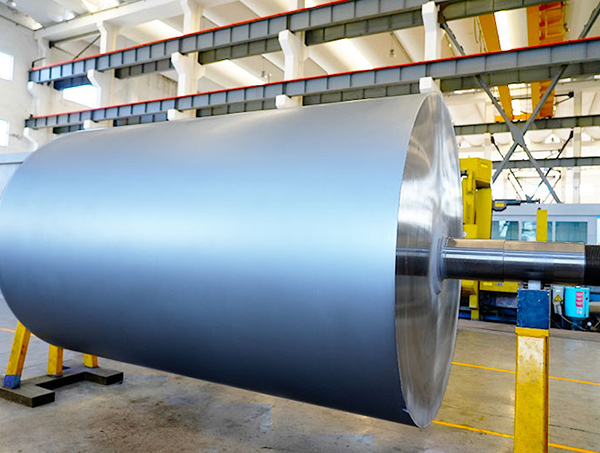
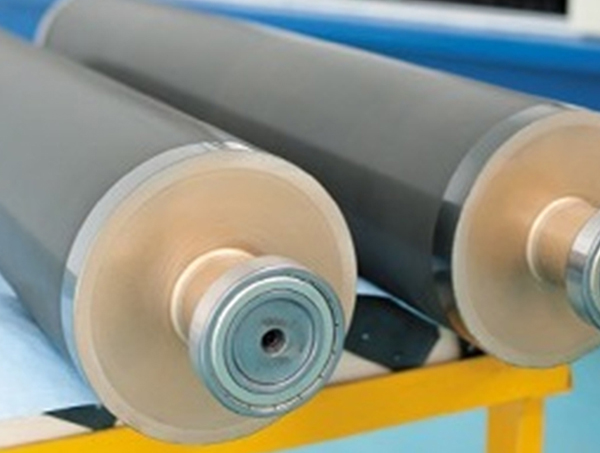
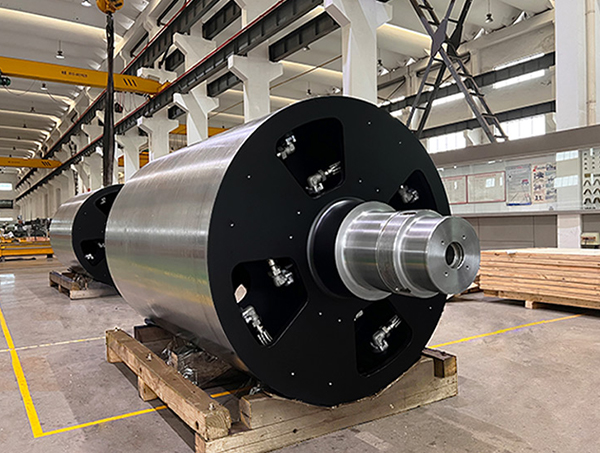
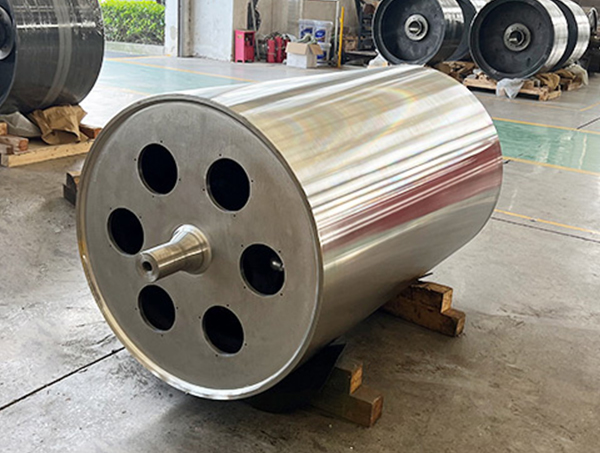
Dedicated to developing and manufacturing various shapes of rolls with different roll structures.
Phone: +86-15371769898
Email: [email protected]
Add: 9 Lifa Avenue, Chengdong Town, Haian County, Nantong City, Jiangsu Province, China
Copyright© 2025 Jiangsu Jinhang Machinery Manufacturing Co., Ltd. All Rights Reserved.
 Custom Thin Walled Roller Manufacturers


 English
 русский
 Deutsch