+86-15371769898
 [email protected]
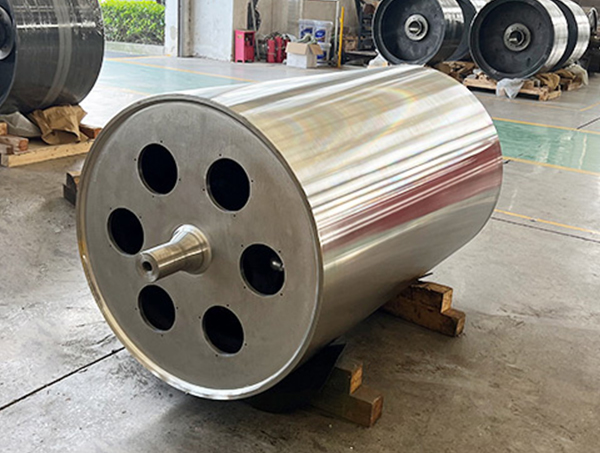
+86-15371769898[email protected]The maintenance and cleaning of Hard Alloy Coated Rollers—typically those utilizing Tungsten Carbide (WC) or Chrome Carbide applied via High-Velocity Oxy-Fuel (HVOF) thermal spraying—require a high degree of technical precision. These rollers are engineered to withstand extreme abrasion, but their longevity is dictated by how well the “binder” (usually Cobalt or Nickel) is protected from chemical and mechanical degradation.
The primary advantage of a hard alloy coated roller is its exceptional hardness (often exceeding 1200 HV), yet the chemical matrix that holds these alloy particles together can be vulnerable. When cleaning these rollers, maintenance teams must avoid aggressive acidic cleaners. Acids can penetrate the microscopic pores of the coating and leach the metallic binder—such as Cobalt—from the Tungsten Carbide matrix. This process, known as “leaching,” leaves the hard particles unsupported, leading to surface pitting, increased roughness, and eventually, the peeling of the coating.
Instead, the protocol should mandate the use of pH-neutral industrial degreasers or mild alkaline cleaners. For rollers used in film extrusion or printing, specialized solvents designed to dissolve specific resins (like PE or PP) or UV inks should be used. It is critical to apply the cleaner using a “Wipe-On, Wipe-Off” technique. Sprinkling or spraying large amounts of solvent directly onto the roller can cause liquid to migrate into the bearing housings or the interface between the coating and the roller shoulder, where it may trigger sub-surface corrosion that is impossible to detect visually until the coating fails.
One of the most destructive habits in a manufacturing plant is the use of steel scrapers, screwdrivers, or wire brushes to remove stubborn buildup from a roller surface. While the hard alloy is far harder than carbon steel, it possesses a much higher modulus of elasticity, making it relatively brittle. Impact from a steel tool can cause “micro-shattering” at the point of contact. These microscopic cracks act as stress concentrators, which, under the pressure of a nip roller, will eventually expand into visible chips.
For safe mechanical cleaning, maintenance personnel should only use high-density polyethylene (HDPE) scrapers or brass-bristled brushes. Brass is significantly softer than Tungsten Carbide, allowing it to scrub away contaminants without the risk of scratching the precision-ground finish. If the buildup is particularly stubborn, such as carbonized plastic or hardened adhesive, “Soft-Blast” cleaning is the industry-recommended solution. Utilizing $CO_2$ (dry ice) blasting is particularly effective because it removes the residue through thermal shock and sublimation without leaving any secondary waste or causing mechanical wear to the alloy surface.
A hard alloy coated roller’s performance is defined by its surface topography. Even a slight change in the $R_a$ (Roughness Average) can lead to air entrapment in film production or uneven ink transfer in printing. Daily visual inspections should be performed under high-intensity LED lighting to check for “hot spots”—areas where the coating appears more polished or duller than the rest of the surface. A polished spot typically indicates a misalignment in the machine frame, where the roller is experiencing excessive friction at a specific point.
Tactile inspections, while seemingly simple, are highly effective for detecting “burrs” or nicks caused by debris passing through the nip. When the machine is in a locked-out state, a technician should run a gloved hand across the entire width of the roller. If the glove “snags,” it indicates a surface defect. In high-speed winding applications, a single microscopic protrusion on a hard alloy roller can cause a repeating defect through thousands of meters of expensive substrate, leading to massive scrap costs.
For critical B2B production lines, visual checks must be supplemented with quantitative NDT methods. Ultrasonic Thickness Testing (UTT) should be performed quarterly. Since hard alloy coatings are typically thin (0.1mm to 0.3mm), monitoring the depletion rate is vital. If the coating thickness in the center of the roller is significantly lower than at the ends, it suggests that the “crown” of the roller is incorrect or the nip pressure is too high.
Another essential tool is the portable surface profilometer. By measuring the $R_a$ value at five points across the roller, maintenance teams can track the “wear curve” of the alloy. Once the surface becomes too smooth (losing its “grip”) or too rough (causing product scratching), the roller can be scheduled for a light diamond-polish regrind before the coating is completely worn through. This proactive approach saves the cost of a full strip-and-recoat process, which is significantly more expensive than a simple surface restoration.
Hard alloy coatings and their underlying steel or aluminum substrates have different Coefficients of Thermal Expansion (CTE). While HVOF coatings are designed with high bond strengths, rapid temperature fluctuations can create intense “interfacial shear stress.” If a cold roller is suddenly introduced to a 200°C production environment, the substrate may expand faster than the coating can accommodate, leading to “spider-web” cracking or delamination.
To prevent thermal shock, always implement a gradual “warm-up” cycle. The roller should be rotated at a slow speed (idle) while the ambient or process temperature is raised incrementally. Similarly, at the end of a shift, the roller should not be “flash-cooled” with fans or water. Allowing the roller to cool naturally while rotating ensures that the thermal contraction occurs uniformly across the entire diameter, preserving the bond between the alloy and the base metal.
When a hard alloy roller is removed from service for an extended period, the primary enemy is atmospheric corrosion. While the Tungsten Carbide itself is inert, the “microporosity” inherent in all thermal spray coatings can allow moisture to reach the bond coat or the substrate. If the substrate rusts, it will push the coating off from the inside out—a failure known as “under-film corrosion.”
The roller should be cleaned, dried, and coated with a thin layer of acid-free rust-preventative oil. It must then be wrapped in VCI (Vapor Corrosion Inhibitor) paper and stored in a temperature-controlled environment. Critically, these rollers should never be stored resting on their coated surfaces. Horizontal storage in “Journal Cradles” is mandatory. Resting a 500kg roller on its alloy coating for months can cause “flat spots” or localized crushing of the coating matrix, which will manifest as vibration or “barring” marks once the roller is returned to the production line.
| Frequency | Maintenance Task | Key Metric / Tool | Objective |
|---|---|---|---|
| Shift Change | Surface Wipe-down | Lint-free cloth / Neutral solvent | Remove surface dust and resins. |
| Weekly | Detailed Visual Check | High-intensity LED / Magnifier | Identify nicks, chips, or hotspots. |
| Monthly | Surface Roughness Test | Portable Profilometer ($R_a$) | Ensure friction coefficient is within spec. |
| Quarterly | Coating Thickness Audit | Ultrasonic Thickness Gauge | Predict remaining life of the coating. |
| Bi-Annually | Alignment & Nip Profile | Pressure-sensitive film | Prevent uneven wear and delamination. |
Q: Can I use high-pressure water jets to clean my hard alloy rollers?
A: It is risky. If there is a pre-existing micro-crack or chip, a high-pressure jet (exceeding 100 bar) can drive water underneath the coating, causing it to “pop” off through hydraulic pressure. Low-pressure washing is safer.
Q: Why is my Tungsten Carbide roller showing signs of rust?
A: The alloy itself doesn’t rust, but the Cobalt binder or the steel substrate underneath might be oxidizing due to porosity in the coating. This usually means the coating was applied without an adequate “bond coat” or sealer.
Q: How many times can a hard alloy roller be reground?
A: Depending on the initial coating thickness, a roller can typically be diamond-polished 2 to 4 times. Once the coating thickness drops below 0.05mm, a full recoat is usually required.
Dedicated to developing and manufacturing various shapes of rolls with different roll structures.
Phone: +86-15371769898
Email: [email protected]
Add: 9 Lifa Avenue, Chengdong Town, Haian County, Nantong City, Jiangsu Province, China
Copyright© 2025 Jiangsu Jinhang Machinery Manufacturing Co., Ltd. All Rights Reserved.
 Custom Thin Walled Roller Manufacturers


 English
 русский
 Deutsch